
July 17, 2026
PAINFUL INTEGRATIONS AND THE COST OF DISCONNECTED GROWTH
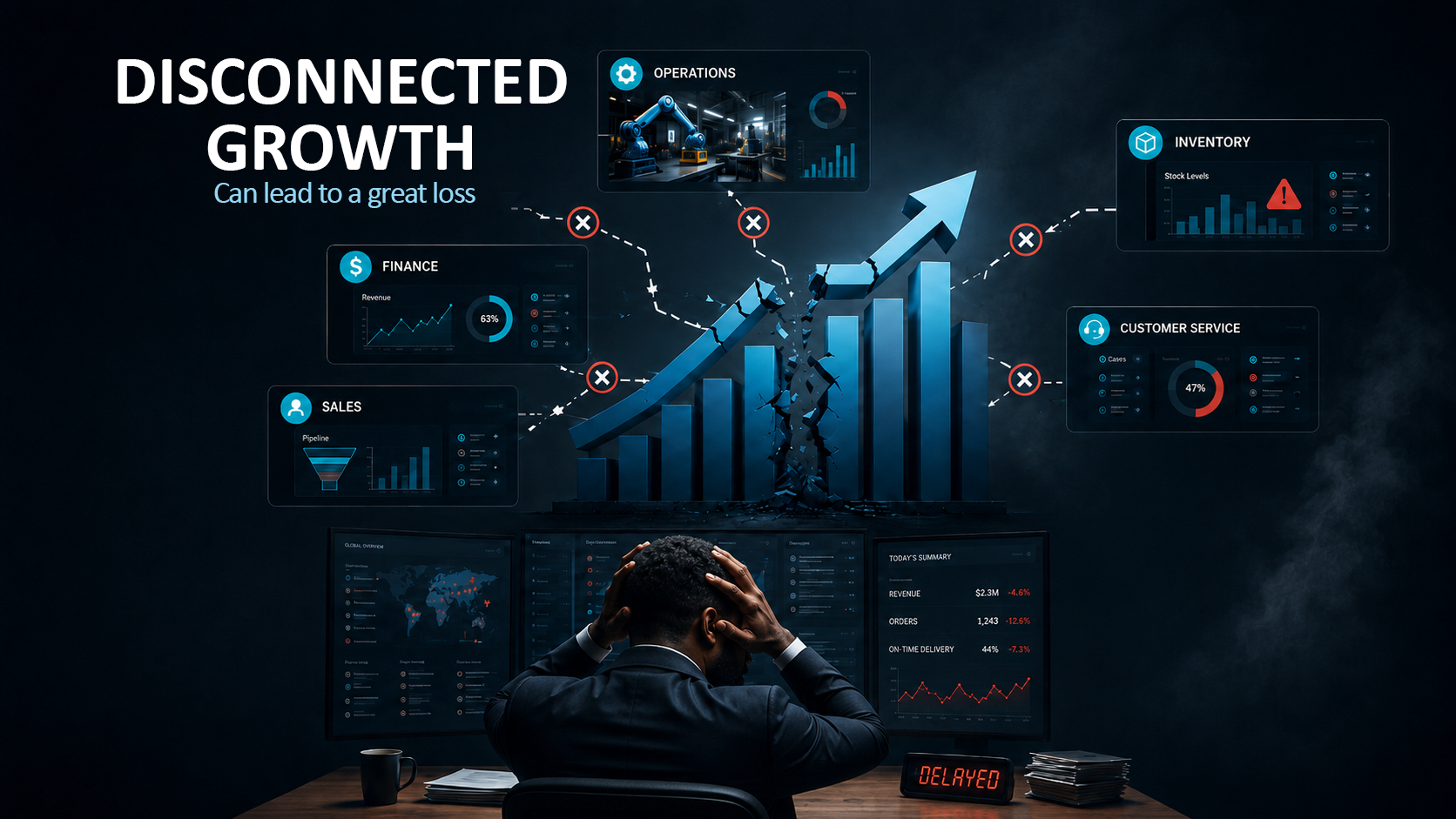
Painful integration is the condition in which an organization has adopted digital tools, but those tools do not exchange information well enough to support how the business actually runs. The result is a familiar contradiction: operations appear digitized, yet the flow of work still depends on manual follow-ups, repeated entries, reconciliations and delayed reporting. Technology exists, but the organization still struggles to see itself clearly.
The cause is usually not one poor technology decision, but the accumulation of several reasonable ones. A system is introduced to solve an immediate problem, a spreadsheet remains because it is flexible, a department adopts a tool that suits its own workflow, and approvals continue through email or chat because that is what people know. Over time, the business develops a patchwork of systems that are individually useful but collectively inefficient.
This is the real meaning of painful integration: not that an organization lacks software, but that its software does not form a coherent operating structure. Information has to be pushed from one point to another by people, rather than moving naturally with the work itself. That is why teams copy data, compare figures, chase updates, export reports and wait for confirmation before decisions can move.
COST OF DISCONNECTION
The cost is measurable. MuleSoft’s 2025 Connectivity Benchmark reports that the average enterprise runs 897 applications, yet only 29% are integrated; the same study found that 90% of organizations regard data silos as a business obstacle, while IT teams spend 39% of their time building custom integrations and automations. McKinsey has also estimated that interaction workers spend nearly 20% of the workweek looking for internal information or tracking down colleagues who can help. In practice, disconnected systems turn skilled employees into human connectors.
For Nigerian businesses, this matters because the operating environment already punishes delay. Input costs are volatile, customers are more impatient, margins are under pressure and management teams are expected to make faster decisions with better evidence. A retailer that cannot connect sales with stock and finance loses accuracy, a manufacturer that cannot connect procurement with inventory and production loses control, and a service company that cannot connect customer records with billing and delivery loses speed.
The same logic applies to the public sector, where records, approvals, budgets, procurement, documents and service delivery depend on the reliability of internal systems. Nigeria’s economy is digitising quickly: ICT contributed 19.78% to real GDP in Q2 2024, and more than 163m Nigerians had internet access as of March 2024. Yet digital adoption does not automatically create digital efficiency; an institution can have many tools and still lack one reliable view of its operations.
WHY LEADERSHIP SHOULD PAY ATTENTION
For the Nigerian CEO, painful integration is therefore not an IT irritation, but a management risk. Growth depends on visibility, cost control, productivity and accountability; if the systems behind the business are fragmented, leadership sees late, reacts late and spends too much time reconciling the past instead of managing the future.
This is particularly important in an economy where MSMEs account for 96.9% of businesses, 87.9% of employment and 46.32% of GDP, because businesses that hope to scale cannot afford for complexity to multiply faster than control.
HOW AXES ERP CLOSES THE GAP
AXES ERP addresses this problem by connecting core operations in one system. Finance, inventory, sales, procurement, HR, CRM, projects, documents, POS and helpdesk become parts of a shared operating view rather than isolated tools. The point is not merely to automate tasks, but to allow information to move with the work: a sale can inform inventory, inventory can guide procurement, procurement can support finance, and leadership can monitor performance without waiting for manual compilation.
The result is a business that flows better. Less time is lost to follow-ups, fewer errors are created by repeated entries, reports become easier to trust, inefficiencies become more visible and decisions move with greater confidence. Profit is not only made through higher sales; it is also protected through better control, lower waste and faster execution.
A MORE DISCIPLINED WAY TO GROW
Painful integration is the quiet cost of disconnected growth. AXES ERP offers a more disciplined alternative: connected systems, clearer visibility and a business structure that gives leaders more control over time, money and performance.